On avian friendship
Kind, very kind, but not nice – even emphatically not nice.
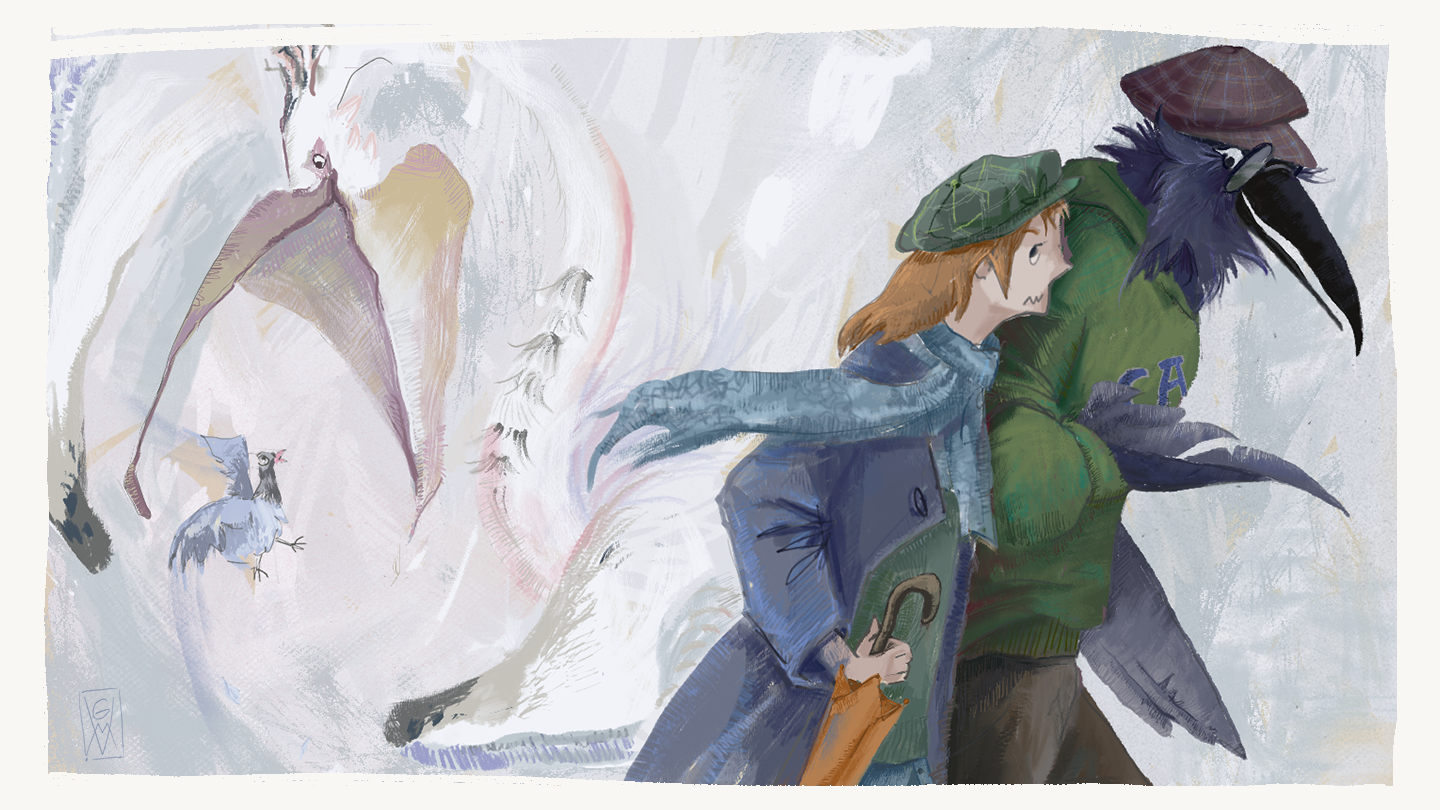
(Archive of Lady Catherine de Turnips, entry 4663-2; discovered by Ekaterina Repina, BA, MA)
My dear friend,
As I have mentioned once or twice, my most recent natural habitat – in addition to museums, trains, coffee shops, ditches, and everything else where one can normally find me when I have no intention to hide – has been London’s Westminster.
I say “Westminster” with some caution. For some people, it stands for “the Parliament” – and that would have made my housing situation quite remarkable even by my standards.
I do everything in my power not to lecture innocent tourists asking for directions “to Westminster” when they mean only the Abbey – and not the City of Westminster, where they most likely already are, nor the Cathedral, nor the Chapel of the same name.
(If you wonder.
Everybody knows Westminster Abbey. Or, at least, they think so.
Westminster Cathedral looks like Hagia Sophia that had been dropped into Hampton Court and rolled a bit on its way, collecting mosaics from different decades of the 20th century. Including, but not limited to, a rather charming depiction of the Tower of London — and St Catherine of Alexandria, so well-known to you.
Westminster Chapel has a coffee shop that I have never been to.
See, it is very difficult just to say “that way!”, should the moment come. Sometimes, as a reminder to myself, I need to keep my left hand tightly behind my back.)
So, my most recent humble abode is a glorious shoebox of a flat within earshot of Big Ben — and several other, less postcard-like, but still curious, sets of sounds. This geographical location has certain disadvantages: numerous ceremonies are less of a matter to observe, but more of a matter to be aware of, just like one needs to keep in mind the schedule of the tides for a coastal walk. The most interesting feature, however, is not the buildings in the proximity, but the people.
Today, I would like to say something about one of my neighbours — at least one of them, for now.
Kind, very kind, but not nice – even emphatically not nice.
My neighbour upstairs is a human version of a crow, and I think I can call him a friend. Like with any avian companionship, one can never be sure. One can only be grateful.
He is an antiquarian.
Old enough to have listened to the Beatles at their concert in Margate.
Young enough to still listen to them — and all the other vinyl records scattered around his flat.
Sometimes, to my utter horror, he threatens to provide me with all sorts of analogue audio equipment that was used over the course of the 20th century – for my further educational advancement in the overgrown field of rock ’n’ roll.
For now, he has mercy on me (and my tiny flat), yet he indubitably can.
Vocally proud of his working-class alignment, he has the intonations of a late-twentieth-century BBC presenter. He assures me that he listened to the radio too much when he was young – somewhere between Essex and Kent, central London and Glasgow music shops – and that it gave him his voice. He listens to the radio constantly: from the shipping forecast to cricket matches.
“English people invented cricket to give them some idea of death,” he loves saying to me. I have zero understanding of cricket.
For now, he forgives me.
Often, he drops his gifts by my door: a glossy magazine, a century-old postcard, a singing mug.
Never knocks, just leaves those offerings there.
He has a weekly rota covering London flea markets.
Covent Garden. Spitalfields. Brick Lane. Notting Hill. All the neighbouring charity shops.
Sometimes, I accompany him and inevitably go away with another gift he has decided I am in need of. A mid-century string of faux pearls. A mug. A silver spoon.
Whenever I come back home from this sort of expedition, I fall asleep almost instantly after seeing decades of somebody else’s domesticity, beauty, affection, and convenience scattered across the pavements and tiny stalls.
He does this every day: he needs to make his 10,000 steps anyway.
“I don’t love antiques. I just sell them for a better price.”
I don't think I ever believed that.
Who made them? Who owned them? When were they used? How interesting are they? — Those are the questions that are of greatest importance to my friend, and he hunts for the clues with all his knowledge, his tiny magnifying glass, and clever, shiny eyes.
He looks for any emblem or hallmark — and he has several books on them across the centuries (but he does not seem to need them, mostly). Among his favourite silver spoons are the ones he calls “tax dodgers”: those that were, from the 18th century onwards, marked by the silversmiths themselves to illegally – as if there were plenty of legal options – avoid paying the government's silver tax. He is often more than happy to provide me with a picturesque, yet not too dramatic, description of a possible execution (sometimes involving tidal waters).
He examines the quality of clasps, knots and strings in the pile of semibroken rubbish for one pound each. Sometimes he succeeds while on his quest.
He teaches me how to recognise fake Tiffany by touch. Sometimes I feel that I can.
Who discarded them and why? How did they end up on the pavement in London? Those are the questions that he could not care less about, or at least he never makes this preoccupation visible. They survived. He knows who brought them here. Sometimes, he has known those people for decades. If he sees something nice – by his standards – he takes it.
He buys broken watches. He repairs them to give to his own selection of charity shops.
He measures temperature in Fahrenheit, especially when in the heat of the summer. When he sees a white wall, he wants to put something nice on it – preferably a picture. When he sees a nice picture, he wants it. From time to time, when I accompany him on his rounds, he asks me to assist him in a noble effort of non-buying more pictures. He inevitably buys more and adds them to the piles scattered around his tiny flat. He frames them himself.
He is sceptical towards the parakeets in St James’s Park.
“Happiness is when a pelican catches a pigeon” he says from time to time.
By our postboxes, we talk a lot about modern London antiques, where relationships are built over decades, centuries-old pieces are sold for a tenner, and a tenner can be spelled ‘Pavarotti’.
(He is a tenor, after all, and Cockney rhyming slang has an excellent sense of linguistic opportunity.)
He uses his postbox to store things he wants to keep downstairs, normally silver spoons. He has an international reputation in silver spoons. Upstairs, his flat holds the rest. Mostly, silver spoons as well.
He knows the years when the window tax was active by heart: it affects the price of the silver spoons.
My neighbour upstairs is a human version of a crow. I think I can call him a friend. Like with any avian companionship, one can never be sure. One can only be grateful.
Yours sincerely,
C. de T.
[Editor's note. The next page is a piece of paper of different quality, presumably, from a notebook; the handwriting is also different throughout.]
Music list
- Peter, Paul and Mary — The House Song
- The Browns — The Three Bells
- Chas & Dave — The Sunshine of Your Smile
- Merle Haggard — If I Could Only Fly
- John B. Sebastian — In the Still of the Night
- Johnny Cash — Hurt
- Joe Perkins — Uncle Eeef
- Janis Ian — At Seventeen
- Rockpile — I Knew the Bride (When She Used to Rock & Roll)
- Judy Collins — In My Life
- Joni Mitchell — For Free
- R.E.M. — Everybody Hurts
- Nanci Griffith — Ruby's Arms
- Tom Waits — I Never Talk to Strangers
- Loudon Wainwright III — Your Mother and I
- Leonard Cohen — Famous Blue Raincoat
- Mickey Newbury — San Francisco Mabel Joy
- Tim Hardin — Hang On to a Dream
- George Jones — He Stopped Loving Her Today
- Peter, Paul and Mary — Right Field