A note on considerate neighbours
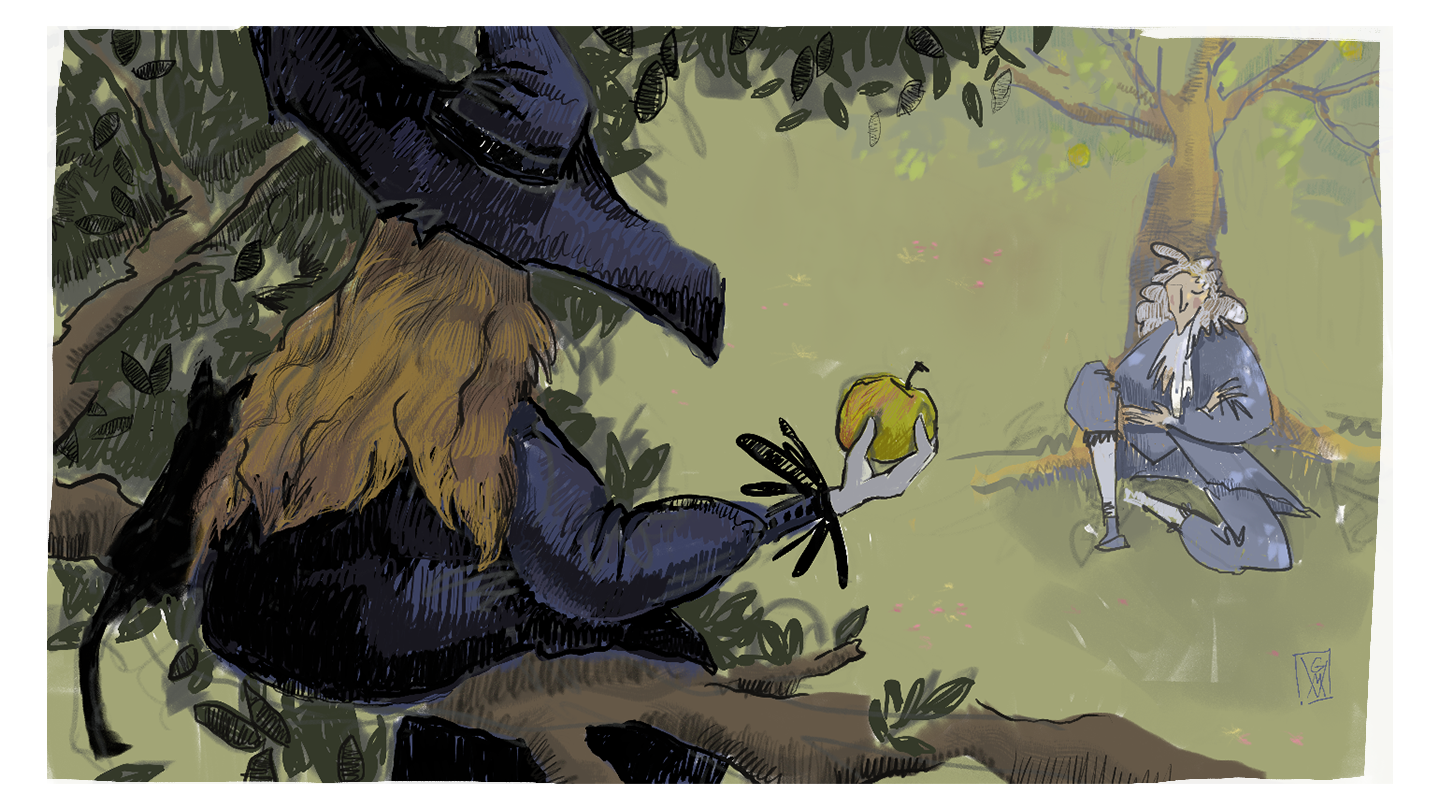
What do Isaac Newton and tigers have in common? Among many possible answers, they both lived, at some point, in the Tower of London.
So, I hope you are still following my train of thought, because once again, we are getting closer to the witches.
(Archive of Lady Catherine de Turnips, entry 4663-double-2; discovered by Ekaterina Repina, BA, MA)
My dear friend,
Do you know that I danced for two music videos?
(Can you see them? – No.)
For another one, I started a street fight.
And, speaking of which, I remember one rather fine summer night in St Petersburg.
(They call them “the white nights” there: when, around the summer solstice, there is no darkness, only dusk – and the sunrise follows the sunset, with all its reds and oranges, with almost no postponement; a reward for the winter, which, at those latitudes, is quite the opposite.)
So, it was a rather fine summer night in St Petersburg, and I passed by a street fight, carefully hidden underneath the oak trees.
“Shhhhhhhhh! Do not use any bad language,” I heard a quiet, almost tender, yet unmistakably drunk voice from inside that street fight. “A lady is passing by.”
Without stopping, I saluted them for their neighbourly consideration: were I in a position to act on my gratitude, I would have happily done so. However, I was a mere stranger in the night.
(That Frank Sinatra’s song was clearly written by a man: there is not the slightest chance that a woman would consider this premise somehow romantic.)
Perhaps this was not the only occasion when I encountered such consideration towards ladies.
On the island of Guernsey, the main town is called St Peter’s Port.
(Yet another place named after a man who was named after a rock — or a stone, if you will. Did you know that Guernsey’s granite industry contributed to the building of London’s Embankment? They say the steps of St Paul’s Cathedral originate somewhere from here, from the Channel Islands.)
In the bay, there is a former tidal island with a castle on it – the Castle Cornet. Almost at the very top of that castle, there is a smallish stone house overlooking, in the summer, a tiny garden in bloom, with its sunflowers and roses — and the sea, with all its masts and decks, and possibly fish.
So, on the wall of that building, there is a tiny stone shelf – almost too easy not to notice. My guide, however, told me that, in fact, that shelf is a witch’s seat, and this neighbourly care protected this building from a gunpowder explosion back in the seventeenth century.
“Witches of Guernsey are so powerful that the danger passed by!”
Unfortunately, I did not have enough time on Guernsey to check this assumption with the local witches themselves and hear their side of that story.
I, however, enclose an artistic rendition of the mentioned local architectural peculiarity in use, with all the liberties of human imagination.
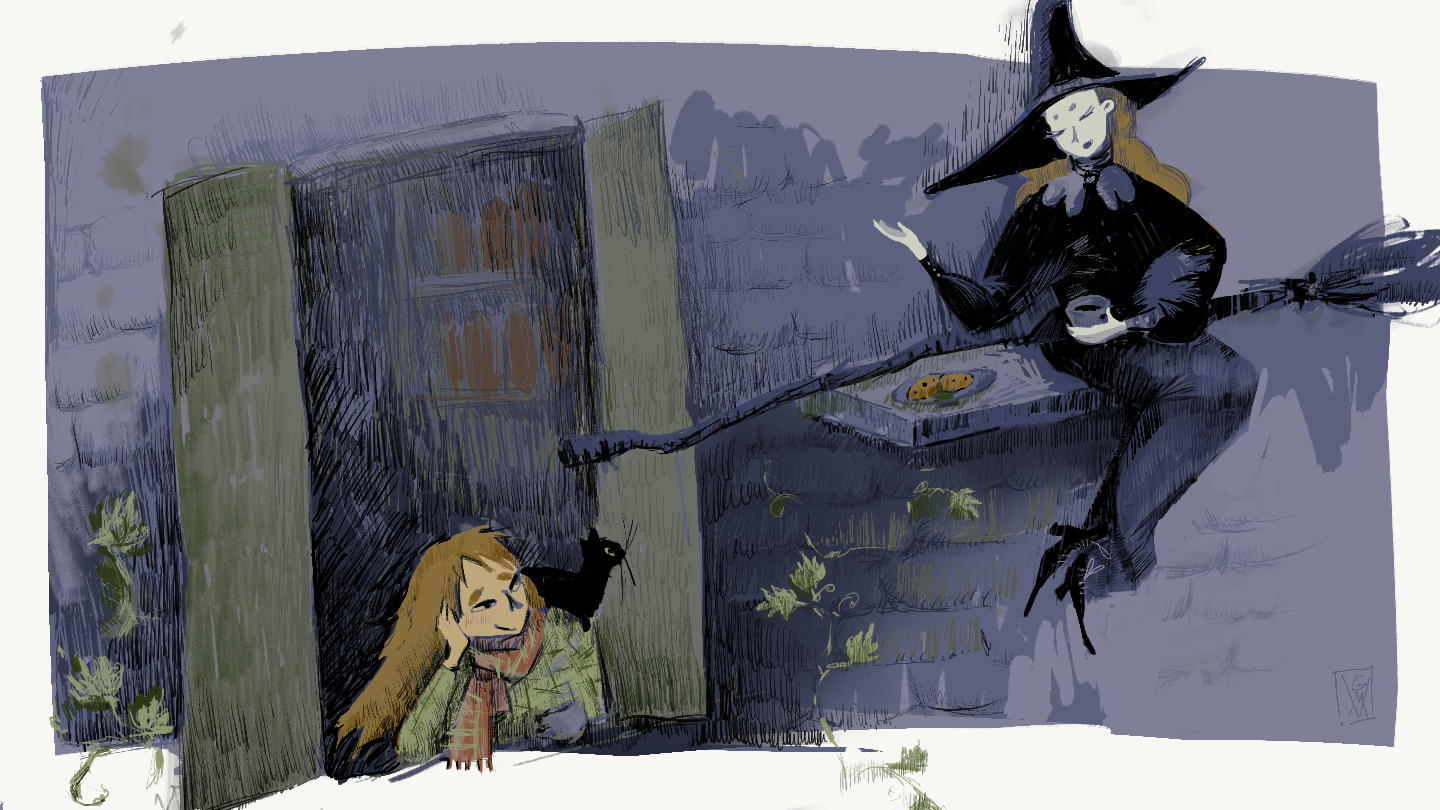
As you, probably, know, I always seek to build mutually respectful working relationships with anything I see, including, but not limited to, witches (who are not normally present within my circle). This approach, however, is far from being shared, and some would argue that it is always best to keep them at a certain distance – or otherwise entertained.
Allow me to elaborate.
What do Isaac Newton and tigers have in common?
Among many possible answers (let us leave “mammals” aside, shall we?), they both lived, at some point, in the Tower of London. The royal menagerie was not removed from the castle until the nineteenth century – by order of my friend the Duke of Wellington, but that is a story for another time – so an overlap is at least plausible. In 1696 Newton was appointed Warden of the Royal Mint, then housed in the Tower, where the street of this name can still be found. If my assumption is right, he lodged not far from all the main routes, and if you ask a beefeater, they will happily – possibly – point out his windows.
One is tempted to wonder how he slept if, during Newton’s residence, the Tower still had tigers (and possibly elephants, porcupines, lions, bears – I have not checked the precise inventory, but I recall some stories). Was he trying to find a shelter under his pillow at night while, dozens of metres away or so, large and not especially contented animals made all sorts of loud and not so contented sounds?
(Maybe tried to barricade his windows to block the sound – while, also, building experiments on the nature of light?)
Let us leave Newton’s earplugs as a mental image. Just like Tolstoy’s Prince Andrei, he is more famous for his encounters with flora, not fauna.
So, I hope you are still following my train of thought, because once again, we are getting closer to the witches.
Just some weeks ago, I was at another Sir Isaac Newton’s address – at a farmhouse where he was raised, not far from Grantham in East Midlands. In contrast to the famous scientist himself (he was the first scientist to be buried in Westminster Abbey – as if he was a king, no more, no less), the famous apple tree remains in situ. The tree is significantly shorter than it could have been after wrestling with thunderstorms and other elements – apparently having decided to survive. If you visit it in the autumn, you can leave with its thought-provoking fruit. Perhaps a couple of boxes of them even.
In the house, you will see at least two things. First, Sir Isaac Newton, among other things, loved to scribble on the walls. Second, by one of the windows, there is another scribble whose authorship is unknown. The latter is quite peculiar in its geometric simplicity: it is an encircled six-petal “daffodil”. They also call them “daisy wheels” and, if you prefer Greek, “hexafoils” – or “witches’ marks” (as in “against them”, not “made by them”). My guide mentioned that these were believed to trap witches – or, probably, demons.
(Even though I can imagine a certain numeric appeal, I, once again, was not able to hear another side of the story.)
There are, however, researchers for whom this protective functionality is more of a fairly theatrical figment: they say, those mysterious symbols are nothing but stonemasons’ marks.
(Here, this means “made by stonemasons”, not “protecting against them”.)
To conclude, I will always support an approach of neighbourly consideration: if one happens to share the space with someone, it is always best to do so with manners.
Yours, as ever,
C. D. T.
PS In the course of my Newtonian investigations, among his vast interests, I stumbled across “the witch of Agnesi”. As you know, mathematics is not necessarily my domain, unless a good story is involved, so the best I can do is introduce it as a “special kind of curve”.
This curve was named after the Italian mathematician Maria Gaetana Agnesi, who described it in her 1748 treatise. Some people would also say that signora Agnesi was the first woman to write a mathematics handbook, the first woman appointed as a mathematics professor at a university – and the second woman appointed as a professor overall.
What is more important, however, is the way her work was translated into English. The Italian name of this curve, la versiera di Agnesi, was read as l'avversiera di Agnesi, where avversiera is translated as “woman who is against God” – and interpreted as “witch”. Hence, “the witch of Agnesi”.
So, eventually, Newton studied witches.